Propagation
This process enriches the graph by adding new links and/or new properties. The new information is added by exploiting existing semantic relationships and values between the involved entities
As of September 2026, the following procedures are in place:
Country propagation: updates the property “country” of a research product. This happens when the research product is collected from an institutional datasource or when the datasource hosting the research product is inserted in a whitelist. For all the research products whose hosting datasource verifies one of the conditions above, the country of the organization providing the datasource is added to the country of the research product: e.g. publication collected from an institutional repository maintained by an italian university will be enriched with the property “country = IT”.

Project propagation: adds a "isProducedBy" relationship (and its inverse) between a Project P and research product R1, if R1 has a strong semantic relationship with another research product R2 and P produces R2: e.g. publication linked to project P “is supplemented by” a dataset D. Dataset D will get the link to project P. The relationships considered for this procedure are “isSupplementedBy” and “isSupplementTo”.

Research product to RC/RI through organization propagation. The manager of the RC/RI can specify a set of organizations whose product are relevant for the community.
Each research product having such a relation of affiliation with at least one organization relevant for the RC/RI will be linked to it.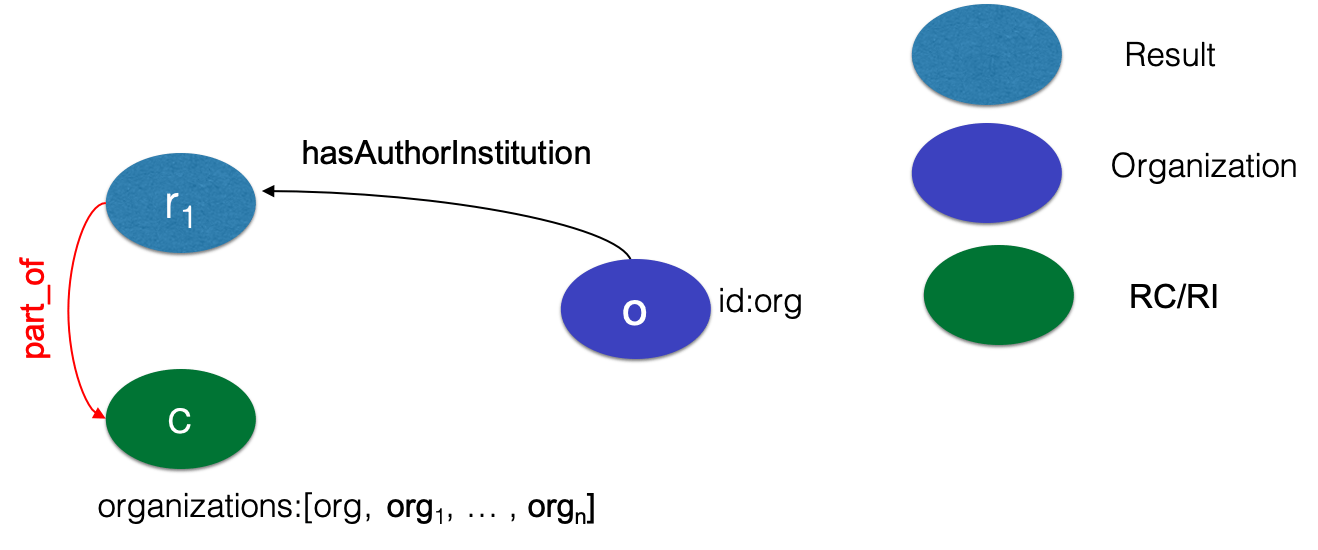
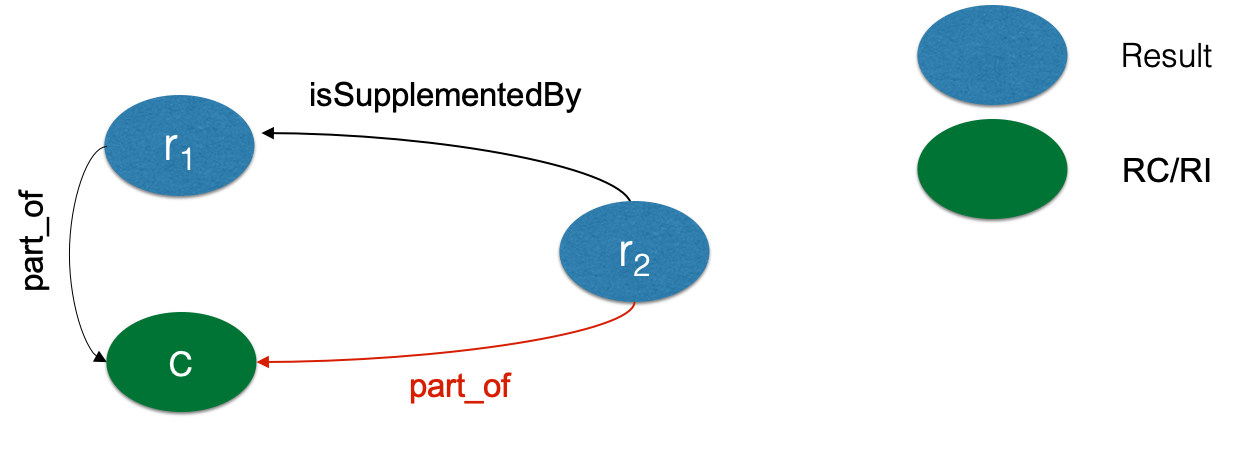
Research product to RC/RI through semantic relation: extends the set of products linked to a RC/RI by exploiting strong semantic relationships between the research products; e.g. if a research product R1 is associated to the community C and is supplemented by a research product R2 then R2 will be linked to the community. The relationships considered for this procedure are “isSupplementedBy” and “supplements”.
ORCID identifiers to research product through semantic relation. This propagation enriches the research products by adding ORCID identifiers to authors. The added ORCID will be marked as "potential" since they have been inserted through propagation. The process starts from the set of research products having at least one author identified by an ORCID, be it asserted by the enrichment from the ORCID dump or added by an earlier propagation. Every research product R1 linked to one of those products R2 by a strong semantic relationship is a candidate: the authors of R1 are compared with the ORCID identified authors of R2 by AIDeR, the OpenAIRE person name matching algorithm, applying in order the exact fullname match, the exact reversed fullname match and the ordered token and abbreviation match strategies described in the enrichment from ORCID section. The two strategies based on the credit name and on the other names of an ORCID profile do not apply here, the enriching authors being authors of the graph and not ORCID profiles. When an author of R1 matches an ORCID identified author of R2, and does not carry an ORCID of its own already, it is enriched with the ORCID found in R2. The semantic relationships to be followed are a parameter of the process; they currently are "isSupplementedBy" and "isSupplementTo". The ORCID of an author of R2 is taken to be the one of its identifiers having the
orcidscheme; when there is none, its singleorcid_pendingidentifier is used. An author carrying several "potential" identifiers and no asserted one is ambiguous, and is not used to enrich anybody.

ORCID identifiers to research product through co-authorship. This propagation gives an ORCID to an author that carries none by following the co-author graph: if an author A of a research product R has published with an author B identified by an ORCID, and B has co-authored elsewhere with an ORCID identified author whose name is the same as A's, then that ORCID is a candidate identity for A. As above, the added ORCID will be marked as "potential". The process first collects, over the whole graph, every pair of ORCID identified co-authors of the same research product, keeping track of how many products they have co-authored together, and every pair made of an author with no ORCID and an ORCID identified co-author of the same product. Joining the two, each author with no ORCID gets the list of the identities that can be reached through its co-authors. Names are compared in the normalised form described in the enrichment from ORCID section, and the candidates found for one author are ranked by the number of distinct co-authors that lead to them. The assignment is deliberately conservative: a candidate identity is discarded when
- it is the only one found, its name is shared by more than one ORCID in the graph, and it is supported by fewer than five co-authored products;
- more than one candidate is found, and the best one is not supported by at least twice as many distinct co-authors as the runner up;
- the same ORCID would be given to two different authors of the same research product;
- another author of the same research product already carries that ORCID;
- the author to be enriched carries an ORCID already, "potential" or asserted.
affiliation to organization through institutional repository. This propagation adds one "hasAuthorInstitution" relationship (and its inverse) between a research product R and Organization O, if R was collected from a datasource D with type institutional repository, and D was provided by O.

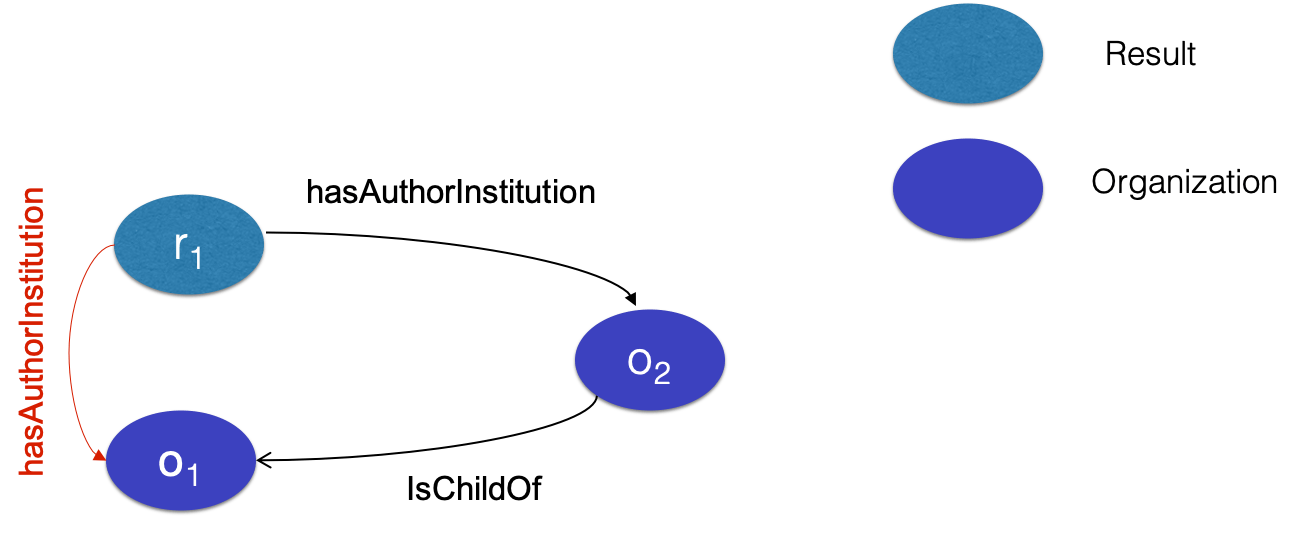
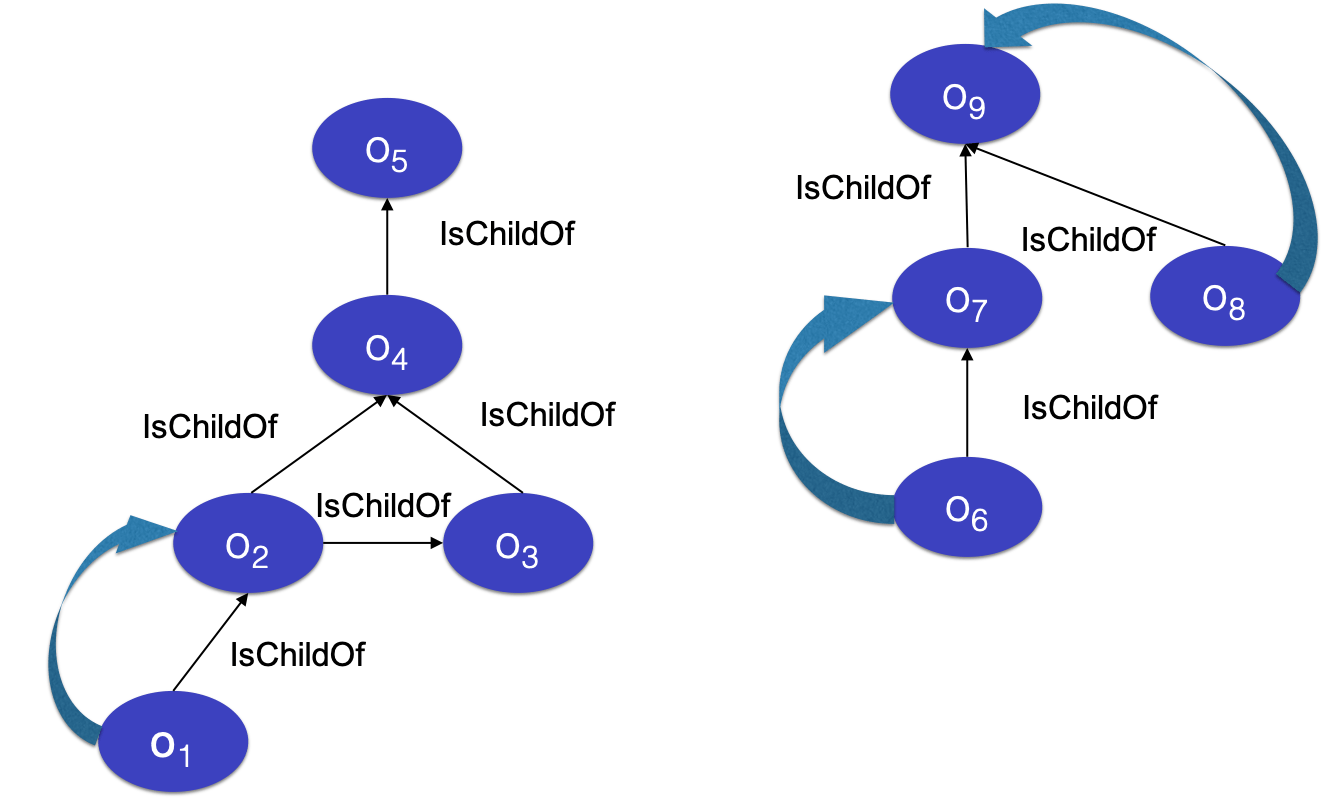
affiliation to organization through semantic relation. This propagation adds one "hasAuthorInstitution" relationship (and its inverse) between a research product R and an Organization O, if R has an affiliation relation with an organization O1 that is in relation "isChildOf" with O.
Where the ORCID identifiers of an author come from
The three processes that add ORCID identifiers to the authors of the research products run in sequence — enrichment from the ORCID dump, propagation through semantic relations, propagation through co-authorship — and each of them can exploit the identifiers added by the previous ones. None of them ever replaces an identifier an author already carries. The scheme and the provenance of an identifier tell which process has added it:
| Process | PID scheme | Provenance |
|---|---|---|
| Enrichment from the ORCID dump | orcid | ORCID_ENRICHMENT |
| Propagation through semantic relation | orcid_pending | authorpid:result |
| Propagation through co-authorship | orcid_pending | authorpid:coauthors |